
4600 Stock Class
Official Ultra4 Rulebook requirements for the 4600 Stock Class, including eligible vehicles, frame and body, engine, drivetrain, steering, suspension and tires.
Section 3 • 4600 Stock Class
The spirit of the stock class is to allow OEM and aftermarket vendors the opportunity to showcase their products while providing a venue for teams to compete in a true drivers’ class in vehicles that closely relate to street driven versions of the same. The driver of record will bear the burden of proving legality of any part of their vehicle including but not limited to; Motor/Transmission, frame length, suspension configuration.
3.1 ELIGIBLE VEHICLES
3.1.1
Any and all four-wheeled, four-wheel-drive production automotive based vehicles are eligible for competition, providing they meet all the rules and regulations specified herein, and with the following limitations and exceptions: Minimum of one thousand (1000) units were produced by the original manufacturer for given model year, for given market/region. Vehicles must have 2 full size seats side by side. Vehicles produced for foreign markets may be imported for competition but features and/or components found on vehicles produced for different regions/markets shall not be combined in any one vehicle if doing so would violate any rules or regulations specified herein.
3.2 FRAME & BODY
3.2.1
Stock frame (frame is considered to be the primary frame rails and all permanent factory cross members) must be retained and must be complete and unmodified. Frames may be reinforced by adding material. No material may be removed for any reason and no section of the frame may be 'massaged' or re-shaped with the following limitations and exceptions:
- Unused bracketry on the frame may be trimmed or eliminated.
- The rear portions of the frame may be trimmed for aftermarket bumpers up to the rearmost portion of the body.
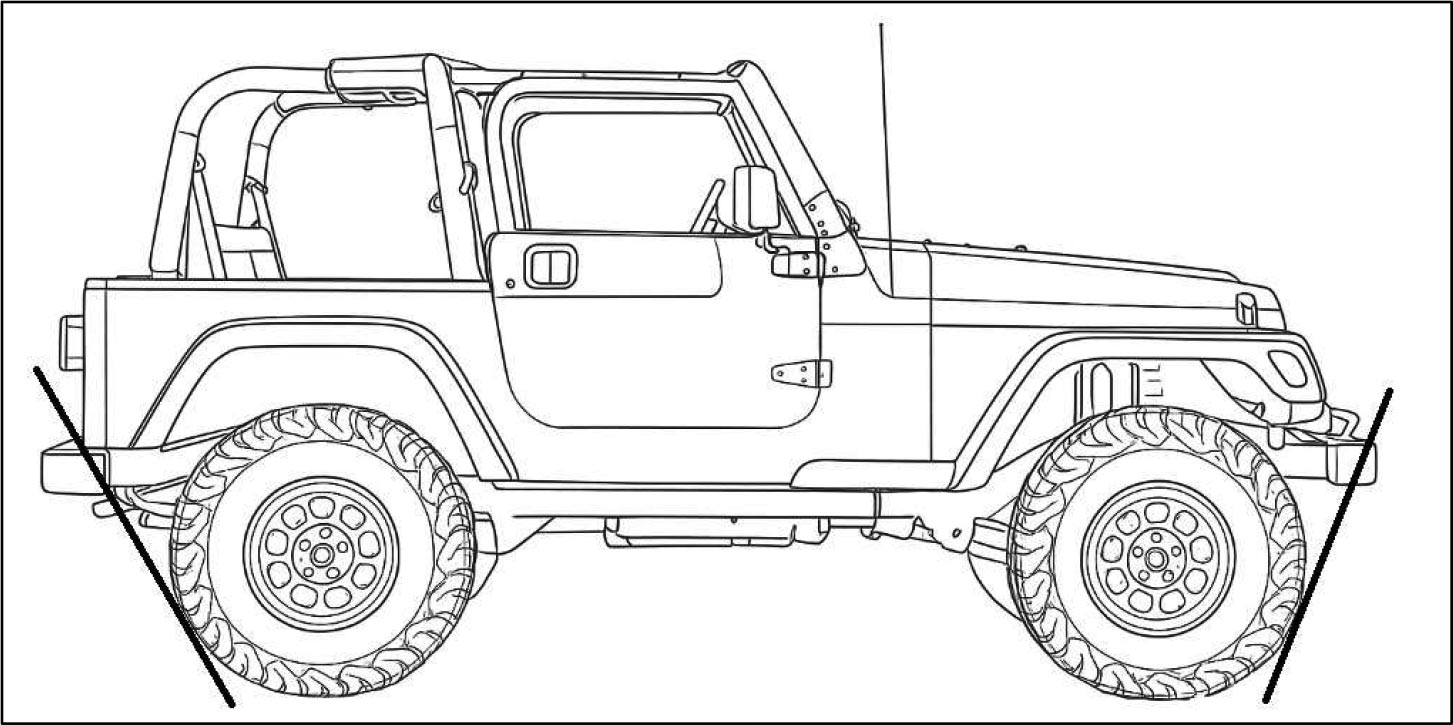
- The front portions of the frame may be trimmed but must retain overall OEM factory length as measured at the top of the frame. Modifications for a winch mount are acceptable but must meet the same requirements.
See diagram below for generally accepted trim allowances
3.2.2
Stock body (body is considered to be the full cab, including all interior and exterior sheet metal, bed, hood, fenders, grill, etc.) required. The body must be complete and unmodified, with the following limitations and exceptions: Holes may be cut in any part of the body for the single and exclusive purpose of allowing roll cage tubes and transmission/transfer case linkage to pass-through the body. Holes may be cut in the firewall, grill and core support exclusively for roll cage and air intake tubes. Roll cage includes the main 6-point structure that surrounds and protects the vehicle’s occupants. The roll cage also includes additional tubing designed to protect the structural integrity of the vehicle and its occupants and must be tied to the standard 6-point occupant cage. Open holes must be kept to within .5"(12.5mm) of the diameter of any tube or linkage that passes through the body. The exception to this rule is the allowance for rocker panel protection limited to the area between the wheel wells. You may cut into the body and/or reinforce this area. You may not interfere with the mating surface of the stock door and doorsill. The stock doorsill must be retained and unaltered.
3.2.3
Stock doors are required but may be modified to create half-doors and/or may also be replaced with tubular doors. Doors must open and close, bolted on panels are not allowed.
3.2.4
Stock windows (glass) are not required, but are permitted, providing they meet DOT regulations. Alternatives to traditional safety-glass may be allowed, on approval of Ultra4.
3.2.5
Front inner fenders must be complete and unmodified, unless specifically required by the 6-point occupants safety roll cage only and does not include allowances for auxiliary tubes, with the following limitations and exceptions: outer fenders (wheel well openings) may be trimmed for the single and exclusive purpose of allowing for tire clearance. Modifications to the outer fenders must preserve the look of the stock wheel wells, as originally manufactured, and must not be trimmed excessively (no more than a 2" (50mm) gap between any part of the outer fender and the tire at full compression)
3.2.6
Front outer fenders may be replaced with OEM-style aftermarket fenders (flared fiberglass fenders are permitted).
3.2.7
Rear inner and outer fenders must be complete and unmodified, unless specifically required by the 6-point occupants safety roll cage only and does not include allowances for auxiliary tubes, with the following limitations and exceptions: outer fenders (wheel well openings) may be trimmed for the single and exclusive purpose of allowing for tire clearance. Modifications to the outer fenders must preserve the look of the stock wheel wells, as originally manufactured, and must not be trimmed excessively (no more than a 2" (50mm) gap between any part of the outer fender and the tire at full compression).
3.2.8
Extensive damage to any portion of the frame or body (prior to race start) may be considered illegal modifications, and repairs may be required, as determined by, and at the sole discretion of the Chief Technical Inspector.
3.2.9
Stock body mounts may be modified or eliminated, with the following limitations and exceptions: The relationship of the body to the frame must remain within 1" (25mm) of stock configuration, as originally manufactured.
3.2.10
Factory headlights or aftermarket equivalent in stock location are required and must be functional.
3.2.11
Factory bumpers are not required and may be modified or eliminated.
3.3 ENGINE
3.3.1
Stock engine must be retained but may be replaced with any available in same make/model/year. Any and all modifications are permitted, with the following limitations and exceptions: Stock engine-block must be retained, as originally manufactured (boring, stroking and other internal engine modifications are all permitted). Forced-induction of all types is not permitted, unless factory-equipped.
3.3.2
If equipped with a water-cooled engine, the radiator size and type is free but must remain within 6" (150mm) of the original location, as originally manufactured. The heater core may be deleted or relocated, if relocated it must utilize OEM inlet and outlets and meet requirements of 2.5.3.
3.4 TRANSMISSION
3.4.1
Stock transmission must be retained but may be replaced with any available in same make/model/year. Any and all modifications are permitted, with the following limitations and exceptions: Stock transmission case/s must be retained, as originally manufactured. Auxiliary transmissions (e. g. secondary transmissions, under / over- drives, etc.) are not permitted.
3.5 TRANSFER-CASE
3.5.1
Any and all transfer-cases are permitted, providing they meet all the additional rules and regulations specified herein.
3.6 DRIVESHAFTS
3.6.1
Any and all driveshafts are permitted, providing they meet all the additional rules and regulations specified herein.
3.7 AXLES
3.7.1
Any and all axle assemblies and associated parts, including portals are permitted, providing they meet all the additional rules and regulations specified herein.
3.8 STEERING
3.8.1
Steering components may be modified or eliminated and steering components/linkage may be installed in any location and orientation, with the following limitations and exceptions: All vehicles must retain some type of mechanical steering linkage (e. g. 'full-hydro' steering is not permitted, unless factory-equipped), and said linkage must be capable of controlling the direction of the steering wheels/tires without the benefit of any additional power-steering aids. The steering box (or rack, if so equipped) must remain within 4" (100mm) of the stock location. No part of the steering linkage shall be oriented so as to be partially or substantially parallel to the frame rails or any part of the suspension linkage, with the exception of the draglink and track-bar (if so-equipped, and unless otherwise- equipped, as originally manufactured). Rear-steer is not permitted.
3.9 SUSPENSION
3.9.1
Wheelbase must remain within 3" (75mm) of stock, as originally manufactured.
3.9.2
Suspension configuration must remain stock, as originally manufactured meaning that leaf springs must remain leaf springs, coil springs must remain as coil springs, torsion-bars must remain as torsion-bars, etc. This includes suspension and axle type, such that solid axle to remain a solid axle, TTB to remain TTB, A-Arm to remain A-Arm, etc. This includes but is not limited to strut, swing axle, sliding pillar, multi-link, semi-trailing arm, and swing arms.
3.9.3
Leaf springs may be replaced with any leaf springs and may be installed in any location and orientation, with the following limitations and exceptions: Leaf springs must be connected directly to the axle assembly, unless otherwise factory equipped. Links/linkage may be installed, but the leaf springs must be capable of locating the axle assembly relative to the chassis in any direction without the use of any such links/linkage. As such, quarter-elliptical springs, transverse leaf springs, and the use of double-shackles (at the forward and rear leaf spring mounting points at the chassis) are not permitted, unless factory-equipped.
3.9.4
Coil-springs and related suspension linkage may be modified or eliminated and replaced with any coil-springs and linkage, and may be installed in any location and orientation, with the following limitations and exceptions: Coil-springs must be connected directly to the axle assembly and chassis and shall not be mounted in any way so as to yield any type of mechanical advantage, unless factory-equipped. Coil-springs shall not be replaced with any type of coil-over shocks, unless factory-equipped (if so-equipped, factory coil-over shocks may be replaced with aftermarket coil-over shocks).
3.9.5
Secondary suspension is not permitted, unless factory-equipped (secondary suspension is considered to be any means or method of supporting any portion of a vehicle's weight and/or affecting the primary spring-rate at any time). As such, springs of all types and airbags, are not permitted.
3.9.6
Air/nitrogen-charged hydraulic bump stops, compressible bump stops made of rubber, foam, or other similar materials are permitted, with the following limitations and exceptions: Bump stops shall not have any action whatsoever on any aspect of a vehicle's performance outside of the last 4" (100mm) of vertical wheel-travel (on compression).
3.9.7
Shock absorbers of any make/model/type are permitted and may be installed with the following limitations and exceptions:
- Only one shock absorber is permitted per wheel/tire (not including spare tires). Vehicles originally equipped with multiple shocks per wheel may run the same number of shocks as originally supplied by the manufacturer in the same locations. It will be up to competitor to verify OEM fitment of multiple shocks on their vehicle.
- Shock absorbers shall not be larger than 2.65" (67mm) in diameter (outer diameter of shock-body) and shall not be capable of any more than 14" (355.6mm) stroke.
- Position-sensitive shocks (including bypass shocks of all types) are not permitted. Adjustable base valves are allowable.
- Shock absorbers must be connected directly to the axle assembly and chassis and shall not be mounted in any way so as to yield any type of mechanical advantage, unless factory-equipped (mounting shock absorbers off-vertical is permitted and shall not be considered a mechanical advantage).
3.9.8
Manual suspension controls (e.g., forced hydraulics) are not permitted.
3.10 WHEELS & TIRES
3.10.1
The intent of the tire rule for the stock class is to restrict tire use to only standard production models designed, sold, and advertised for use on highway vehicles. Therefore, all tires used in competition shall be readily available to the public from any local distributor. Tires with special construction, compounds, etc. created for the sole purpose of competition will not be allowed.
3.10.2
Tires must be DOT-approved as defined in 2.18.7, with a maximum outside diameter of 35” (or equivalent) when utilizing portal hub technology on the axle. Measurement is as specified on the tire’s sidewall by the tire manufacturer. A DOT-approved 37” tire may be used on a vehicle axle with non-portal hub technology.
Recent Comments





This site uses cookies. Find out more about cookies and how you can refuse them.